From the skeleton to the restoration.
Expanders, aligners and surgical wafers on one side. Guided implants and prosthetics in exocad on the other. Most labs pick one. Cases that need both stop having a handover problem.
Six families. One manufacturing thread.
Expansion, correction, alignment and surgery are where a case is won or lost. Implants and prosthetics finish what the skeleton started. Running through all six is metal 3D printing — because laser-melted CoCr does things cast and bent metal never could.
Full catalogue
Every appliance we design, grouped — plus custom work, which is the normal case.
Browse the list 01Skeletal expansion
MSE and MARPE designed to the suture, the bone available and the miniscrew path.
Jump to section 02Functional & Class II
MARA, I-bar and bar-type correctors, Herbst, distalisers and space maintainers.
Jump to section 03Aligner design
Staged setups, attachment and IPR planning, retention and refinement sequences.
Jump to section 04Orthognathic
Virtual surgical planning, intermediate and final wafers, cutting and repositioning guides.
Jump to section 05Guided implantology
Prosthetically-driven planning in exoplan, with tooth-, mucosa- and bone-supported guides.
Jump to section ★Metal 3D printing
Laser-melted CoCr and titanium frameworks — one piece, no solder joints, repeatable.
Jump to section 06Prosthetic design
Single units through full-arch in exocad — anatomy built for the space you actually have.
Jump to sectionIf it can be designed, it is on this list.
Pick a design from the catalogue or describe something that is not on it. Fully customised appliances are the normal case here, not a surcharge.
A no-weld construction leaves the printer or the mill as a single piece — no soldered band junction to fatigue, and nothing to assemble by hand. If you have a printer but no welder, that column is the one to read first.
Bone-borne expansion
- MSE and MARPE, planned to palatal bone depth TADno-weld
- Hybrid Hyrax, tooth- and bone-borne TADweld
- Four-miniscrew TAD expander TADweld
- Benefit-anchored expanders TADno-weld
- Tooth-borne rapid palatal expander weld
- BMX / Brölex expander TAD
- Printed TAD insertion guides no-weld
- Surgically assisted expansion planning (SARPE)
Beneslider & sliders
- Beneslider — maxillary molar distalisation TADno-weldsliding
- Mesial Slider — mesialisation and space closure TADno-weldsliding
- Distal Slider TADno-weldsliding
- Mesial-Distal Slider, combined mechanics TADno-weld
- Custom abutment-mounted constructions TADno-weld
- Insertion guides for paired palatal miniscrews no-weld
Correctors
- MARA / FMA mandibular advancer weld
- Herbst and telescopic, fully digital weld
- I-bar and bar-type correctors
- Pendulum and Distal Jet weld
- Horseshoe distaliser TADno-weldfrictionless
- Twin block and bite-jumping designs
Arches and maintainers
- Transpalatal arches and Nance buttons passive
- Lingual arches no-weldpassive
- Anchorage bar no-weldpassive
- Band-and-loop and space maintainers passive
- Molar intrusion device (“mousetrap”) TADno-weld
- Molar uprighting appliances
- Habit breakers
Retainers and splints
- Printed and thermoformed retainers
- Fixed bonded retainers with placement jigs
- Full-coverage stabilisation splints
- Deprogrammers and night guards
- Bonding trays and indirect transfer jigs
Everything in this family is printed or thermoformed. Nothing here needs a welder.
Describe it instead
Most of what we build started as a sketch on a message. Send the objective, the anatomy and the anchorage you have available, and we will draw something for it.
Custom construction is the default assumption here. There is no separate “bespoke” tier.
Describe a case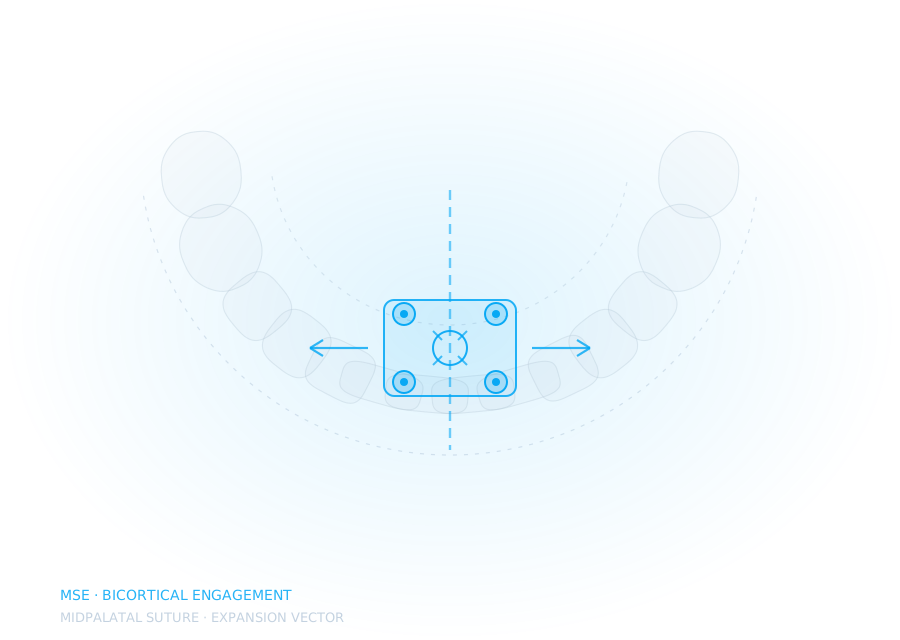
Expansion is a bone problem before it is an appliance problem.
An expander that fails usually failed at screw position, not at screw turns. We place the miniscrews on the CBCT first — palatal bone depth, cortical thickness, nasal floor and root proximity — then build the appliance around where the anchorage can actually go.
- MSE and MARPE designed on merged CBCT and intraoral scan data
- Miniscrew position planned for bicortical engagement where anatomy allows
- Palatal bone thickness and nasal floor clearance checked before the frame is drawn
- Root proximity and greater palatine neurovascular bundle avoided by design
- Bonded and banded variants, printed or milled frameworks
- Placement guide designed alongside the appliance so the plan survives the surgery
Correctors that survive contact with a real patient.
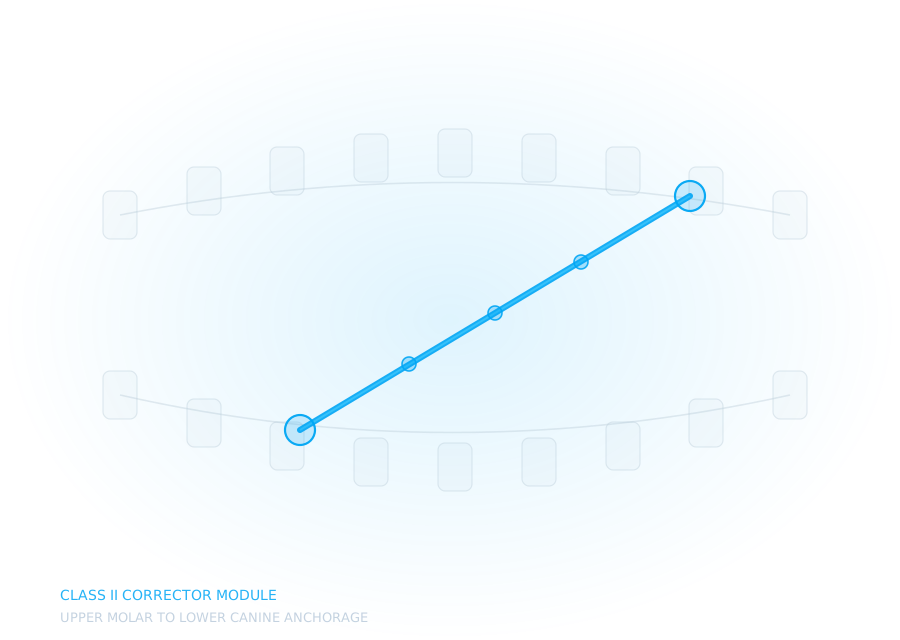
Fixed functionals and skeletally anchored sliders live or die on anchorage, path of insertion and how much abuse the attachment takes. We design them against the occlusion you actually have, and tell you when the anchorage plan will not hold.
- MARA, I-bar and bar-type Class II correctors
- Benefit-system constructions — Beneslider, Mesial Slider, custom abutment appliances
- Herbst and telescopic designs, including fully digital fabrication
- Distalisers, Pendulum and molar uprighting appliances
- Bonded and banded attachment design with realistic retention
- Space maintainers, nance and transpalatal arches
- Anchorage assessment before design — including when to add a TAD
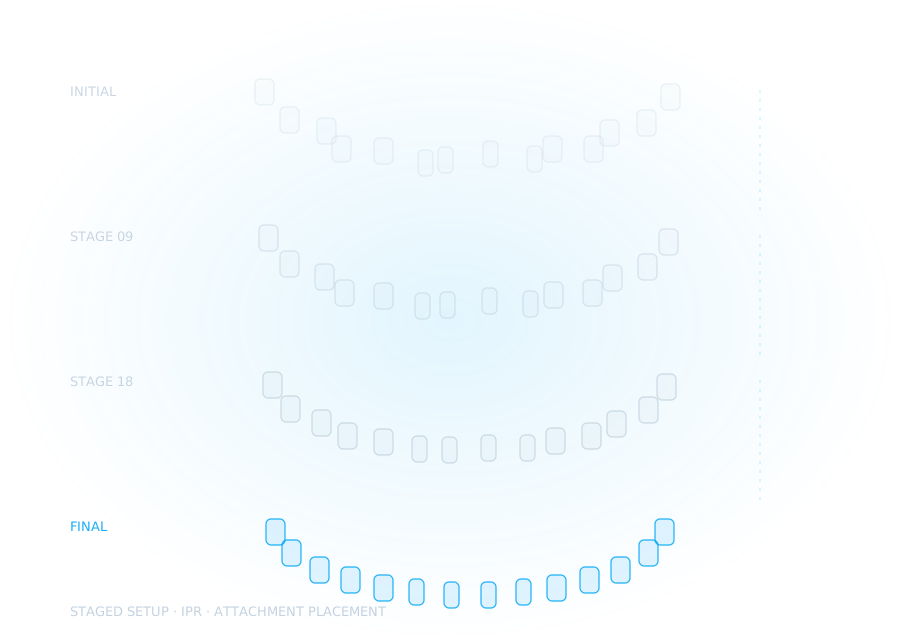
The staging is the treatment plan.
Anyone can move teeth to a final position on screen. The value is the order they move in, what holds while they do, and whether the attachments can actually deliver the force you drew.
- Staged setups with movement rates you can defend biologically
- Attachment design and placement, with retention checked stage by stage
- IPR scheduling — how much, where, and at which stage
- Elastics, buttons and auxiliary planning built into the sequence
- Refinement and mid-course correction setups
- Retainer design, printed or thermoformed
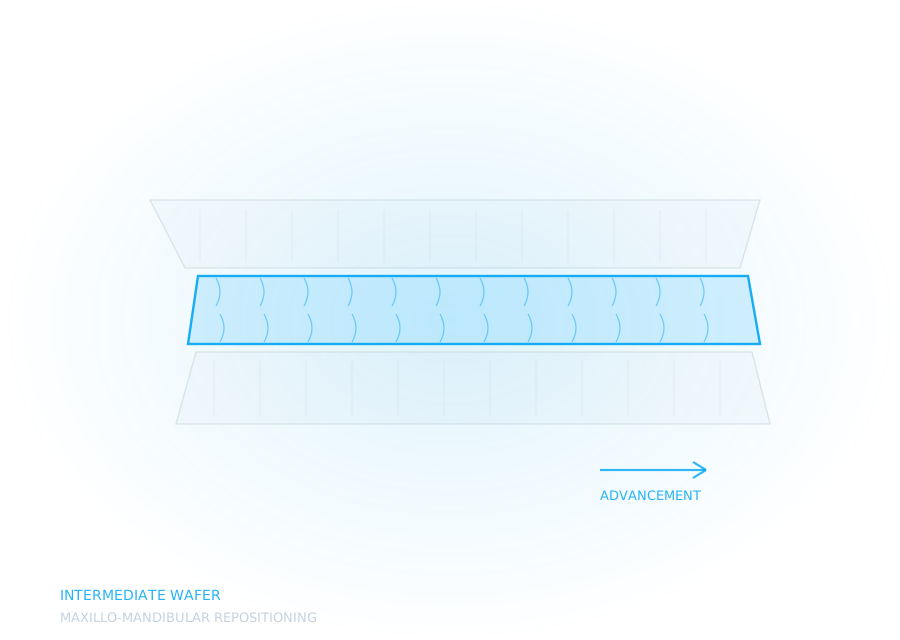
Wafers that seat in theatre, not just on screen.
Virtual surgical planning is only worth the wafer that comes out of it. We build intermediate and final wafers to the movement you approved, with occlusal indexing deep enough to locate but shallow enough to seat under drapes.
This is the part most orthodontic CAD services do not offer. If your case needs surgery, you usually have to leave your design lab and find a second one — and the plan changes in the handover. It does not have to.
- Virtual surgical planning on CBCT merged with intraoral scans
- Le Fort I, BSSO, bimaxillary and genioplasty movements
- Intermediate and final wafer design with realistic indexing depth
- Cutting guides and repositioning plates where the workflow supports them
- Cephalometric superimposition — planned against pre-treatment
- Splints for TMD and pre-surgical stabilisation
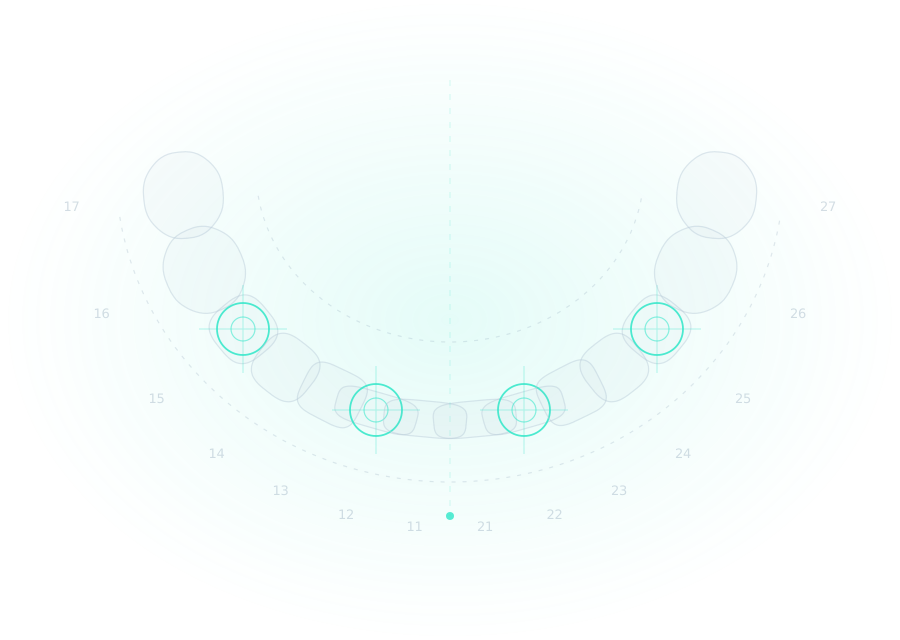
The restoration decides where the implant goes.
Bone-driven placement gives you an implant that osseointegrates beautifully in a position the prosthesis cannot use. We plan backwards from the restoration in exoplan, then check the bone will actually allow it.
- Prosthetically-driven planning on CBCT merged with intraoral scans
- Tooth-, mucosa- and bone-supported surgical guides
- Pilot and fully-guided sleeve systems, to your kit
- Bone volume, nerve proximity and sinus floor assessed before position is fixed
- Emergence profile and screw-access angle checked at planning, not at delivery
- Full-arch: multi-unit positioning, conversion prosthesis and verification jigs
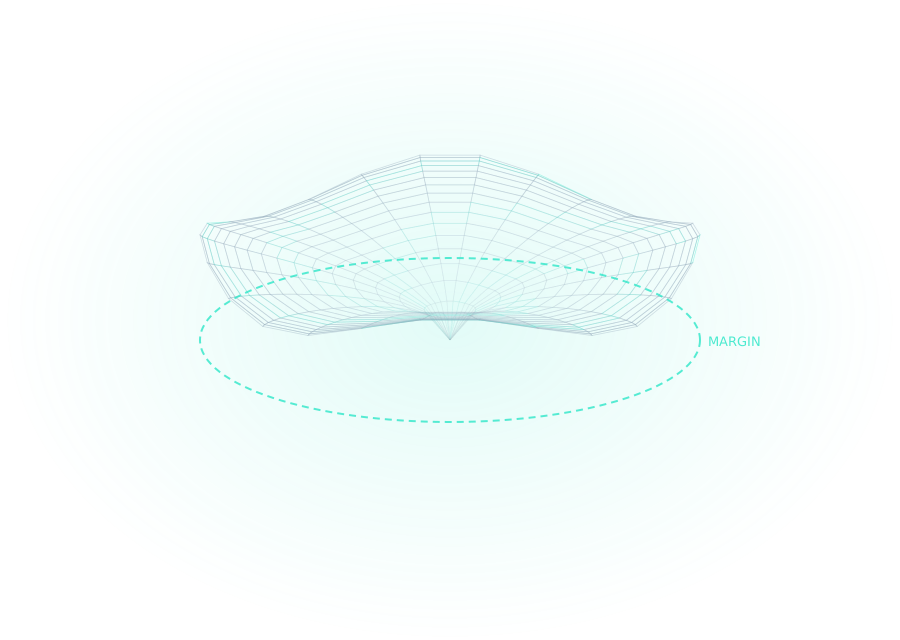
Anatomy with a reason for every surface.
Designed in exocad, to your material library and your milling parameters. Library teeth are a starting point, not an answer — and we will tell you when the design is fighting the preparation rather than quietly compensating for it.
- Inlays, onlays, veneers and full-coverage crowns
- Bridges, cantilevers and long-span frameworks
- Screw-retained and cement-retained implant restorations
- Custom abutments and titanium-base workflows
- Full-arch hybrids, bars and monolithic bridges
- Material-specific thickness, connector sizing and cutback for layering
- Digital smile design and printed mock-ups for the aesthetic cases
What to expect, by case type.
Working days from the moment we have usable records. If a scan or a CBCT needs redoing, the clock starts again — and you will hear that the same day, not the day before you needed it.
| Case type | Standard | Rush | Records needed |
|---|---|---|---|
| Retainer / simple appliance | Next working day | Same day | Upper, lower, bite |
| Space maintainer, TPA, Nance | Next working day | Same day | Arches, bite |
| Aligner setup | 2–4 days | 2 days | Full arches, bite, treatment objectives |
| MSE / MARPE expander | 2–3 days | 1–2 days | DICOM + STL, plan approval |
| MARA / I-bar / Herbst | 2–3 days | 1–2 days | Arches, bite in construction position |
| Occlusal splint | Next working day | Same day | Arches, bite at target VDO |
| Metal framework (CoCr / Ti) | 2–3 days design | 1–2 days | Arches, bite, design brief |
| Orthognathic wafers (VSP) | 4–7 days | 3–4 days | CBCT, scans, photos, planning session |
| Single crown / onlay | Next working day | Same day | Upper, lower, bite |
| Bridge, up to 5 units | 1–2 days | Next day | Upper, lower, bite, pre-op |
| Implant crown / custom abutment | 1–2 days | Next day | Scan body, tissue scan, bite |
| Surgical guide (implant) | 2–3 days | 1–2 days | DICOM + STL, plan approval |
| Full-arch hybrid | 3–5 days | 2–3 days | Full records, photos, VDO notes |
Three ways to use the lab.
Start with one case. Move to a plan when the volume justifies it. Nothing is locked in, and nothing renews without you saying so.
Per case
For trying us out, or for the appliance you would rather not design at 9pm.
- No minimum volume
- Two rounds of revisions included
- Print-ready STL, or native project files
Practice plan
A monthly block of design units for clinics running a steady ortho list.
- Priority slot in the daily queue
- Unlimited revisions within scope
- Named designer who learns your appliance preferences
- Monthly review call on the difficult cases
Lab partner
White-label design capacity for orthodontic laboratories.
- Work delivered under your brand
- Your file structure and print parameters
- Overflow cover for holidays and peaks
- Optional training so you can bring it in-house
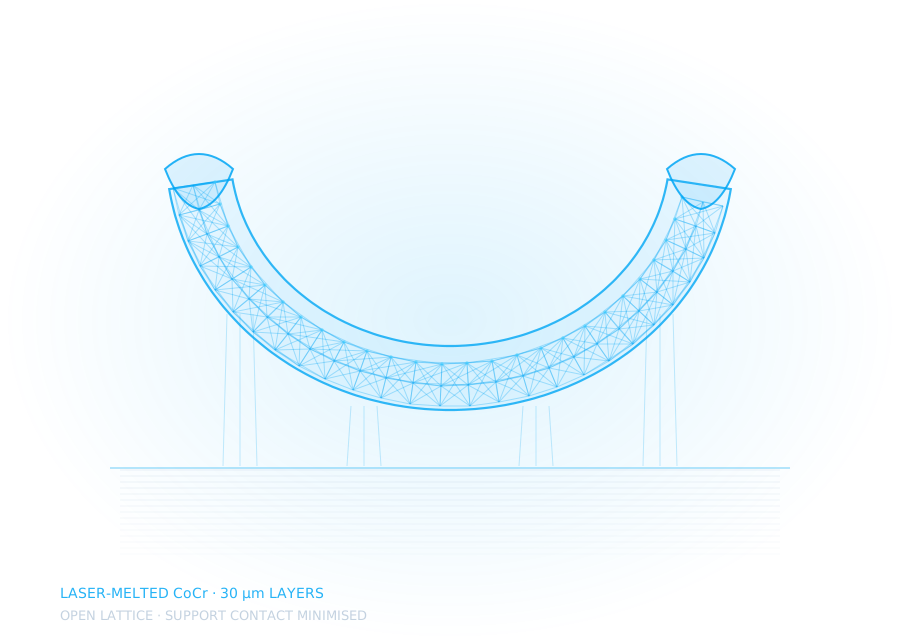
Geometry you cannot cast, bend or solder.
Laser-melted CoCr and titanium change what an appliance can be. One-piece frameworks with no solder joints. Open lattices that cut weight without losing stiffness. And the same geometry, identically, every time it is built.
- Expander frameworks printed as one piece — no soldered band junctions to fatigue
- Herbst, MARA and bar-module components with integrated attachment geometry
- Transpalatal arches, Nance buttons and lingual arches from the scan, not the wire
- Removable partial denture frameworks with printed retentive lattice
- Implant bars and hybrid frameworks in CoCr or titanium
- Build orientation, support strategy and stress-relief allowance resolved at design stage
Every metal file leaves here with orientation and support contact already decided. A framework oriented badly warps on stress relief, and no amount of finishing recovers the fit.
We design. We don’t own the machine.
Planning and design is the whole product here. Fabrication — resin or laser-melted metal — runs through production partners, either yours or one of ours.
That is a deliberate choice, not a gap. A lab that owns a mill has a quiet incentive to recommend milling. A lab with an idle printer has an incentive to find something to print. We have neither, so when we tell you a case does not need an appliance, or that a different material would hold better, there is nothing behind the advice except the case.
It also means we design to your machine rather than ours. Send your printer, resin or metal system and its parameters, and the file arrives built for them. Industrial laser melting is not something most practices will ever own, and pretending otherwise helps nobody.
You produce it
We deliver print-ready STL, oriented, supported and nested for your machine, with recommended resin and parameters. You print the same day the file lands. Fastest route, lowest cost, and you keep full control of the physical article.
We arrange production
For practices without a printer, and for anything in CoCr or titanium, we route the design to a vetted metal-printing partner and hand you the finished article. Adds fabrication and shipping time to every quoted turnaround — we will give you the real date, not the design date.
Either way, the file is yours
No proprietary format, no export fee. If you later buy a printer, or change partners, everything we have designed for you moves with you.
Getting the records right.
Most cases we hand back are handed back for the same few reasons. Two minutes here saves a day later.
Ask us to check recordsScan the full palate, not just the teeth
Expander design needs palatal vault anatomy. A scan trimmed at the gingival margin cannot support a MARPE frame, and we will ask you to re-scan.
Send the DICOM, not a screenshot
For any skeletal or surgical case we need the volume itself to merge and measure. A JPEG of the coronal slice tells us nothing we can plan on.
Record the bite you actually want
For functional appliances, the construction bite is the prescription. Take it deliberately, record the vertical, and tell us how you arrived at it.
State the objective, not just the appliance
"Expand 7mm at the first molars" is designable. "Send an MSE" is a guess about a case we cannot see.
Practicalities.
Restorative and implant work is designed in exocad DentalCAD, with exoplan for guided planning. Appliance and aligner work runs through 3Shape Ortho System, Deltaface and Blue Sky Plan depending on the case, and orthognathic planning uses Dolphin 3D. Output is open STL unless you ask for native project files, which we are happy to supply if you work in the same platform.
Yes. Send your printer, mill, resin and any parameters you already trust and we will design to them. Cement gap, minimum thickness, connector cross-sections, milling compensation, wire gauges, band thickness and retention undercuts all change with the material — and a design tuned for someone else's machine is a design that fits badly.
For MSE and MARPE, yes — screw position is part of the appliance design, not a separate step. We report the palatal bone depth at each planned site so you can see why the position was chosen, and design the placement guide alongside the frame.
You are. We design to the objective you set and we will raise concerns when the records suggest the plan is difficult, but diagnosis, treatment planning and the patient in front of you remain entirely yours. Nothing we produce is a clinical instruction.
Send pseudonymised DICOM wherever possible — a case reference rather than a patient name. We do not need identifying details to plan an expander. Volumes are deleted six months after delivery unless you ask otherwise, and your local data-protection rules take precedence over anything we suggest.
Cobalt-chrome for most orthodontic frameworks and partial denture work, titanium where weight or biocompatibility drives the choice. Design differs between them — wall thickness, lattice cell size, shrinkage allowance and stress-relief behaviour are not interchangeable, so tell us the alloy and the machine at the start rather than after the file is built.
No, and deliberately so. We are a planning and design practice; fabrication runs through partners. If you print in-house we hand you a file built for your machine. If you do not, we arrange production and hand you the finished appliance — that adds fabrication and shipping to the timeline, and the quote will say so. Owning no production hardware is what lets us tell you a case does not need the thing we would otherwise be selling.
Send one appliance and judge us on it.
Pick the case you would normally dread designing. We will hand it back with the reasoning written out.