Learn the workflow. Not just the software.
Anyone can show you where the buttons are. The hard part is knowing why a miniscrew goes where it goes, when a wafer will bind, and which cases you should refer rather than attempt.
Five routes in.
Each one is built around cases you design yourself. You finish with files you made, not a certificate you watched someone earn.
Digital Orthodontic Foundations
For orthodontists who have bought the scanner and are not yet getting their money’s worth out of it.
- Scanning technique that stops causing re-takes
- Reading and fixing your own scan and CBCT errors
- Merging volume and surface data without drift
- Designing and delivering a retainer and a TPA end to end
- Choosing what to keep in-house and what to send out
Skeletal Expansion & TAD Planning
MSE and MARPE from CBCT to a frame that holds, for clinicians already placing miniscrews.
- Reading palatal bone depth and cortical thickness properly
- Screw position for bicortical engagement, and when it is not available
- Frame design: bonded, banded, printed, milled
- Age, suture maturation and the honest limits of non-surgical expansion
- Planning and printing an expander for one of your own cases
Virtual Surgical Planning
Orthognathic planning and wafer design, taught by the cases that went sideways rather than the highlight reel.
- Records for surgical cases, and what makes a CBCT unusable
- Le Fort I, BSSO, bimaxillary and genioplasty movements
- Building intermediate and final wafers that seat in theatre
- Indexing depth, relief and the reasons wafers bind
- Superimposition: auditing what you planned against what you got
Aligner Design Intensive
For clinicians and technicians who want to own their setups instead of accepting someone else’s.
- Staging order and biologically defensible movement rates
- Attachment design that actually delivers the force you drew
- IPR: how much, where, and at which stage
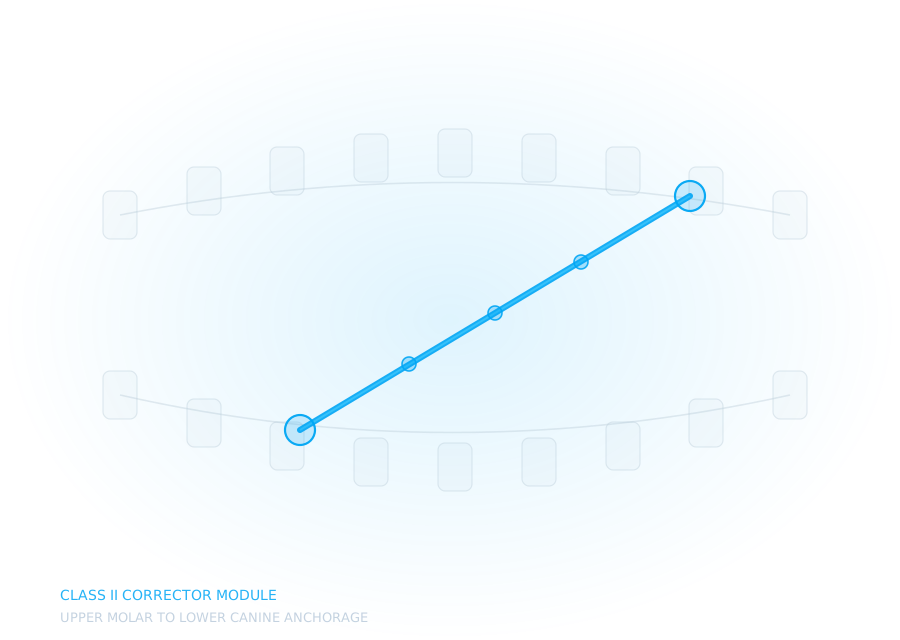
- Anchorage planning, elastics and auxiliaries
- Refinement setups and mid-course correction
Guided Implantology & exocad
Prosthetically-driven planning and restorative design, for clinicians and technicians who want to own both ends.
- Planning backwards from the restoration in exoplan
- Guide support: tooth, mucosa, bone — and when each fails
- Emergence profile and screw-access decisions at planning stage
- Crown, bridge and custom abutment design in exocad
- Material selection, thickness and connector sizing that survives
How a cohort actually runs.
You send a case before week one
Real records from your own practice. The course is then taught partly against your cases, which is why cohorts stay small enough that this is possible.
One live session, one design task
Ninety minutes live, recorded. Then something to design before the next session. Nobody learns CAD by watching, and we are not going to pretend otherwise.
Your work gets critiqued, by name
Designs are reviewed on screen with the whole cohort. It is uncomfortable for the first fortnight and it is the reason people improve.
Recordings, files and a channel that stays open
You keep every recording, every design file and access to the alumni channel. Most questions arrive weeks after a course ends, which is exactly when they should.
One-to-one, on your own cases.
For clinicians who do not need a curriculum — they need someone experienced looking over their shoulder before they commit to a plan. Booked in blocks, used as you need them.
- Fortnightly sessions on live cases you are about to start
- Screen-share planning: we plan it together, you execute
- Superimposition review — what the plan predicted versus what you got
- Direct message access between sessions for the urgent ones
- Honest advice about which cases to refer rather than attempt
Who this is and is not for.
We would rather you skip a cohort than sit through one that was never aimed at you.
- You own or have access to a scanner, a CBCT and design software
- You can commit ninety minutes a week and a case to work on
- You want to understand decisions, not memorise click paths
- You are comfortable having your work critiqued publicly
- You are a technician who wants the clinical reasoning behind the appliance
- You want a certificate for a CV and nothing else
- You are looking for a product demonstration disguised as teaching
- You have no access to cases or data to practise on
- You want someone to design your appliances for you — that is the Design Lab
Upcoming cohorts.
Cohorts are capped so that every case gets looked at. When a cohort fills, the next date is the next date.
| Programme | Format | Length | Cohort size | Next intake |
|---|---|---|---|---|
| Digital Orthodontic Foundations | Online | 4 weeks | 12 | Enquire |
| Skeletal Expansion & TADs | Online + 1 live day | 6 weeks | 10 | Enquire |
| Virtual Surgical Planning | Online + mentorship | 8 weeks | 8 | Enquire |
| Aligner Design Intensive | Online | 6 weeks | 12 | Enquire |
| Guided Implantology & exocad | Online | 6 weeks | 12 | Enquire |
| In-practice workshop | On site, your clinic | 1–2 days | Your team | By arrangement |
Before you sign up.
For the clinical cohorts, access to scan data, CBCT volumes and a design licence makes an enormous difference — you learn by doing. If you do not have a licence yet, most vendors offer trial or educational versions and we will point you to the right one before the course starts.
Every one, and you keep them. Time zones and emergency appointments are real, and we would rather you catch up than drop out.
Accreditation varies by country and by regulator. Tell us where you practise when you enquire and we will be straight with you about what we can and cannot certify in your jurisdiction.
Yes — the in-practice workshop is one or two days on your equipment, with your cases and your nurses in the room. It tends to move a clinic further in two days than three months of individual courses.
Tell us early. You can carry unfinished work into the alumni channel, or roll into a later cohort once at no extra cost. What does not work is disappearing for four weeks and hoping to catch up in the last one.
Get on the list for the next cohort.
Tell us where you are in your digital journey and we will tell you which programme — if any — is the right one.