
What this is
Every case that arrives is checked before design starts. Not as a courtesy — as the first step of the work, because designing on a record that cannot support the appliance is worse than not starting.
Where a record will not do the job, you get told the same day, with a specification of exactly what to re-capture. Not "please rescan", which wastes another appointment. Which region, to what extent, and why.
What gets checked
Coverage
Does the scan actually contain the anatomy the appliance needs? A palatal expander needs the vault to its full depth. A framework needs the tissue it will rest on. The most common failure is a scan that is perfectly adequate for a crown and useless for an appliance, because it was taken as though it were for a crown.
Completeness of the arch
Full arch means to the distal of the last erupted tooth. A scan that stops at the second molar constrains anchorage planning in ways that are not obvious until the plan needs that tooth.
Surface quality where it matters
Noise on a buccal surface nobody uses is irrelevant. Noise on the fitting surface of a planned framework is not. We look at the surfaces the design depends on rather than at the scan as a whole.
The bite
Whether it is present, whether it is in the position the case notes describe, and whether both arches actually agree with it. Bite records disagree with their own scans more often than people expect.
Radiographic registration
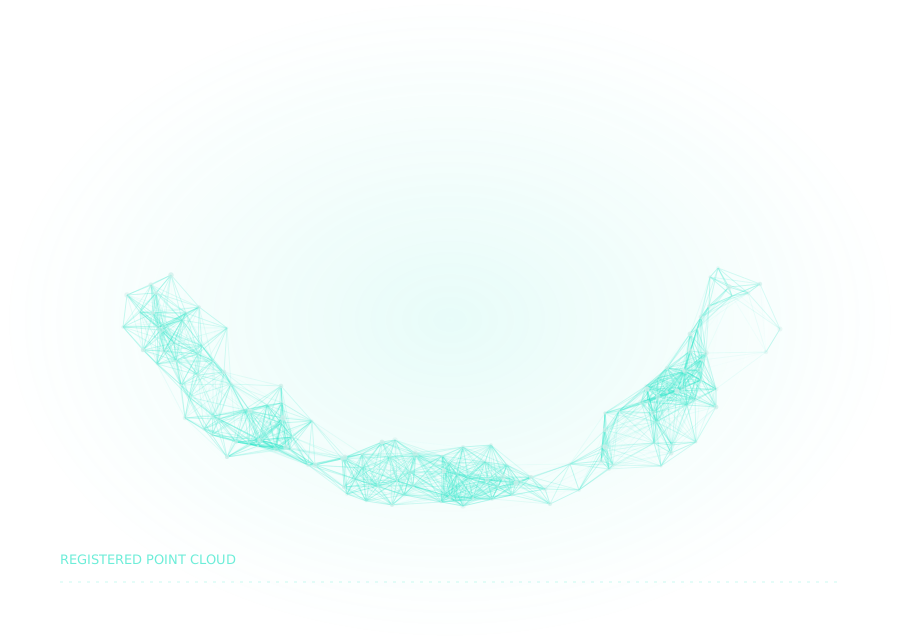
Where the case merges scan with CBCT, whether there are enough clean, well-distributed surfaces to register against — and whether scatter has degraded the ones the merge needs.
What you get back
If the scan is fine, nothing — the case just runs. If it is not:
- What is missing or unusable, shown rather than described
- Why it matters for this appliance, specifically
- What to capture on the re-scan, in enough detail to brief whoever is holding the wand
- Whether any part of the case can proceed meanwhile
Why we do not just work around it
Because working around a missing surface means inventing it, and an invented surface fits the patient the way an invented surface fits a patient. The design would look complete and would not seat.
It is also worth saying that a rejected scan is not a criticism of whoever took it. Scanning for an appliance is a different job from scanning for a restoration, and most scanner training covers the second one.
Common causes, in order
- Vault not captured, on any case involving the palate
- Arch stopped short of the terminal molar
- Bite recorded in a different position from the one described
- Scatter degrading the surfaces a CBCT merge needs
- Soft tissue captured mid-movement, so the surface is a blur of two positions
More on this: the record errors that cost the most.
Timeline
Same working day. It happens before the case enters the design queue, not after it.
Planning and design support only. Diagnosis, treatment planning and the clinical decision remain entirely with the treating clinician.