
What we need from you
- Intraoral scans of both arches and the bite. Full arches, to the distal of the last erupted tooth
- Photographs, including occlusals of both arches
- Radiographs — an OPG at minimum; periapicals where root proximity or root length will decide whether a movement is safe
- Periodontal status, including recession and biotype at the lower incisors. This constrains how far the arch can be pushed forward more than anything else on the list
- Your constraints. How much IPR you are willing to do, at which contacts, and any teeth that are off limits — heavily restored, previously traumatised, thin enamel
The space audit
This is the part worth being unsentimental about. If the arch is short by six millimetres, that six millimetres has to be found, and there are only three places to find it:
- Interproximal reduction. Roughly 0.2–0.5 mm per contact depending on the tooth and the enamel available, which adds up faster anteriorly than people expect
- Transverse development. Real in the premolar region, largely tipping in the adult lower arch, and limited by the buccal plate
- Proclination. The one that quietly balances the books when nobody has decided the other two — and the one that costs attachment in a thin biotype
We total these before staging anything and show you the arithmetic. If the three together do not reach the discrepancy, the plan does not work, and that is a conversation to have now rather than at refinement. Sometimes the honest answer is that this is an extraction case, or a case for a different appliance.
Where the IPR goes in the sequence
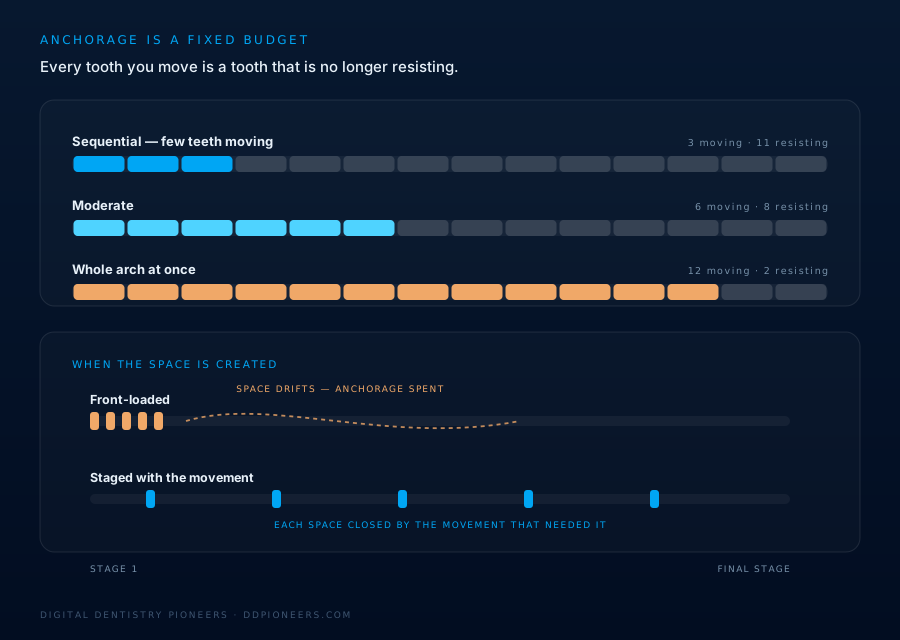
Front-loading the reduction is the intuitive choice and usually the wrong one. Space opened early gets consumed by whichever teeth move first, which is not necessarily the teeth it was intended for.
Distributing the reduction across phases — taking it immediately ahead of the movement that needs it — keeps the space where it is needed and keeps the posterior segment doing less work. In arches where that segment is the only anchorage available, the staging is what decides whether you need a TAD.
The trade-off is chairside: distributed IPR means reduction at more visits rather than one. That is a real cost to you, so we will tell you what it is at the plan stage, not after the trays are printed.
Attachments and what they are actually for
Attachments are placed to make specific movements achievable, not decorative. Rotations of round-rooted teeth, extrusion, and anything asking for bodily movement need geometry the aligner can grip. Where a movement is being asked for that the attachment cannot deliver, better to know at the setup than to discover it as a persistent discrepancy at tray twelve.
What leaves the lab
- The staged setup, with the movement per stage visible rather than summarised
- An IPR schedule — which contact, how much, before which stage
- The attachment plan, with what each one is there to achieve
- The space audit, written down, so the plan can be argued with
- Suggested review points where a mid-course correction is most likely to be worth taking
The setup comes back to you for approval before anything is committed. Change it. It is easier to argue about a stage now than to run a refinement later.
Where these cases go wrong
Four ways, in roughly the order they cost you time:
- The IPR on the plan does not happen at the chair, or happens partially. Every subsequent stage inherits the shortfall
- Posterior anchorage drifts, so the space created ends up distal instead of where the crowding is
- The setup asks for a rotation the attachment cannot deliver, and the tracking loss is blamed on compliance
- The space audit was never done, and the shortfall resolves itself as incisor proclination
More on the sequencing logic here: staging an aligner case so it actually tracks.
Timeline
Three working days for the staged setup from usable scans. Revisions after your review are same or next day, because at that point we are changing a plan rather than building one.
Planning and design support only. Diagnosis, treatment planning and the clinical decision remain entirely with the treating clinician.