


A final position is a statement of intent. A staged sequence is a plan for how force will be delivered, what will resist it, and in what order. The first is easy to produce and easy to approve. The second is where cases succeed or quietly stop tracking.
Every stage borrows anchorage from somewhere
An aligner is a single connected appliance. There is no separate anchor unit, the teeth you are not moving at this stage are the anchorage for the teeth you are, and they are all inside the same piece of plastic.
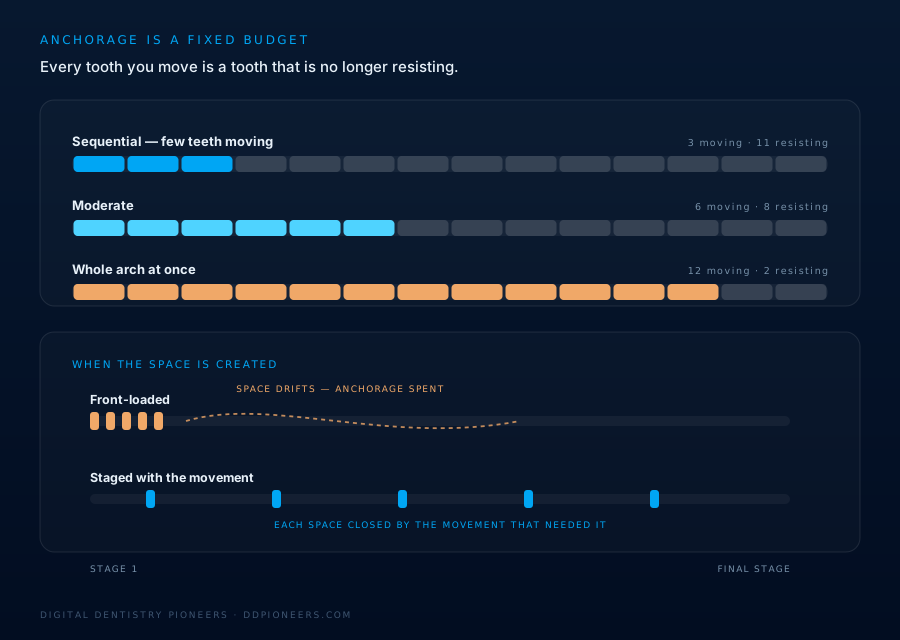
Which produces the central constraint: the more teeth you move simultaneously, the less there is left to move them against. A stage that asks for movement across the whole arch at once has distributed its own anchorage away, and the result is not that everything moves slowly. It is that reciprocal movement occurs where you did not want it, and the aligner stops fitting.
Sequential movement is not merely slower and safer. It is often the only version that works, because it preserves an anchor unit large enough to resist what is being asked.
Why front-loading IPR loses anchorage
Interproximal reduction creates space. The instinct is to create it early — get the space, then use it. The instinct is wrong, and the mechanism is worth being precise about.
Space opened before it is needed does not stay where you put it. It redistributes. Teeth on both sides of a newly created contact-point gap drift into it under the aligner's own seating forces, and drift is uncontrolled. You have converted a planned space into an unplanned movement, and consumed part of the anchorage that later stages depended on.
Perform IPR in the stage where the adjacent movement uses it. The space then has somewhere to go and is closed under control, in a direction you chose.
Attachments deliver the force, or nothing does
Aligner material can push. It struggles to pull, rotate a round tooth, or extrude — those need a surface to engage against, which is what an attachment is for.
What decides whether one works:
- Its geometry relative to the movement. An attachment shaped for retention does not deliver rotation. The active surface has to oppose the direction of travel
- Its position on the crown, which sets the moment arm and therefore whether the tooth translates or tips
- Whether the aligner can actually seat over it. Attachments that engage well at the start can prevent full seating once teeth have moved around them
- How many are competing. Every attachment adds seating resistance, and past a point the aligner no longer fully engages anywhere
Retention should be checked stage by stage, not designed once at the start. Tracking loss frequently begins as an attachment that was adequate at stage 4 and inadequate at stage 22, because the surrounding geometry changed.
Movement rates you can defend
Setup software will happily distribute a movement evenly across however many stages you specify. That produces a number per stage which may be biologically reasonable or may not, and the software has no opinion either way.
Different movements tolerate different rates. Tipping is comparatively forgiving; bodily translation, root torque and extrusion are not, and asking too much per stage does not slow the tooth down. It loses tracking, at which point every subsequent stage is built on a position the patient never reached.
The judgement is: what rate can this movement, on this tooth, in this patient, actually achieve, and staging should follow that answer rather than a target stage count.
A sequence that holds together
There is no universal order, but one principle survives most cases: move against resistance while you still have it. Which gives a rough shape:
- Establish the anchor unit first. Whatever will resist for the next fifteen stages should be settled and not itself being asked to move
- Do the movements needing most anchorage early, while the largest number of teeth are still available to provide it. Leaving the hardest movement to the end is the common error
- Create space in the stage that consumes it, not before
- Sequence rotations before translations where they compete for the same space, a rotated tooth occupies more arch length than a corrected one
- Finish with settling, planned as stages rather than hoped for
Each of these is a judgement rather than a rule, and a case with a good reason to break one should break it. The point is that the order is a decision, and treating it as an output of the software is how it stops being one.
Plan the refinement from the beginning
Refinement is not a failure. Treating it as one produces over-ambitious initial setups that lose tracking early, which is the failure.
A first series that achieves most of the correction predictably, followed by a short refinement addressing what remains, finishes sooner and more reliably than a single series attempting everything and losing fit at stage 15.
Planning and design support only. Diagnosis, treatment planning and clinical decisions remain entirely with the treating clinician.