
The principle is not controversial. Decide where the tooth needs to be, then find out whether the bone will allow an implant to support it there, then decide what to do about the gap between those two answers.
What happens in practice is often the reverse: the volume is opened, the best available bone is identified, an implant is placed along that axis, and a restoration is designed around whatever position results. That is a legitimate way to get an implant to integrate. It is not prosthetically driven planning, and calling it that obscures a decision that should have been made deliberately.
The difference is which one moves
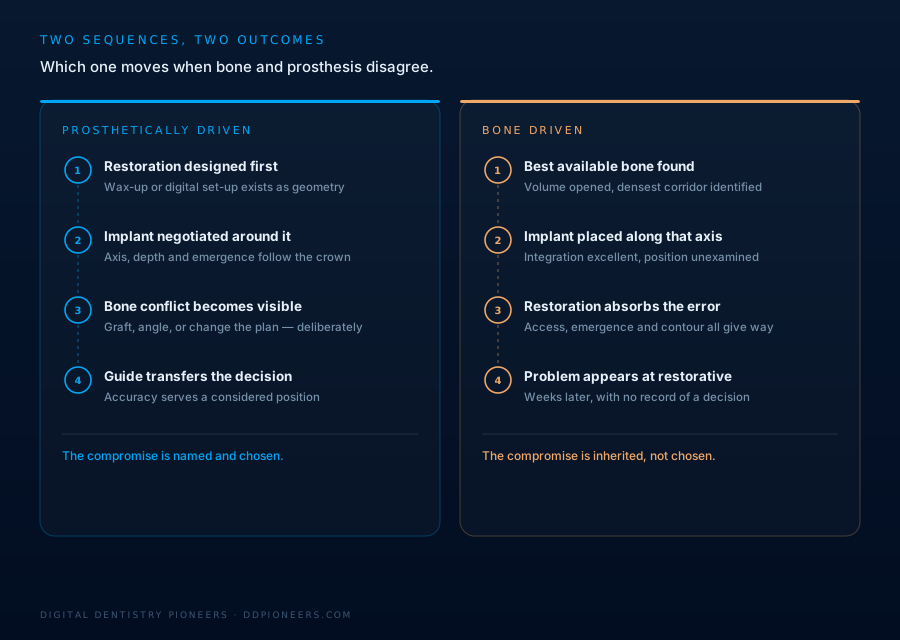
In a genuinely prosthetically driven plan, the restoration is fixed first and the implant position is negotiated around it. When bone will not permit the ideal position, that becomes a visible decision with named options: graft, angle the implant and accept an angulated abutment, change the restorative design, or move the tooth position and tell the patient why.
In a bone-driven plan the restoration is the variable. It absorbs every compromise silently, and nobody records that a compromise was made. The implant integrates, the case looks successful on the radiograph, and the problem surfaces at the restorative stage as a screw access hole in the wrong place.
Four tells
1. The restoration was never designed, only imagined
A plan is not prosthetically driven because someone thought about the crown. It is prosthetically driven because the crown exists as geometry in the planning software, a diagnostic wax-up, a digital tooth set-up, or a scan of a provisional, and the implant was positioned against it.
If the only representation of the final restoration is a mental image, the plan is bone-driven. The most direct question to ask: where is the file of the tooth this implant is supporting?
2. Screw access was checked after the position was fixed
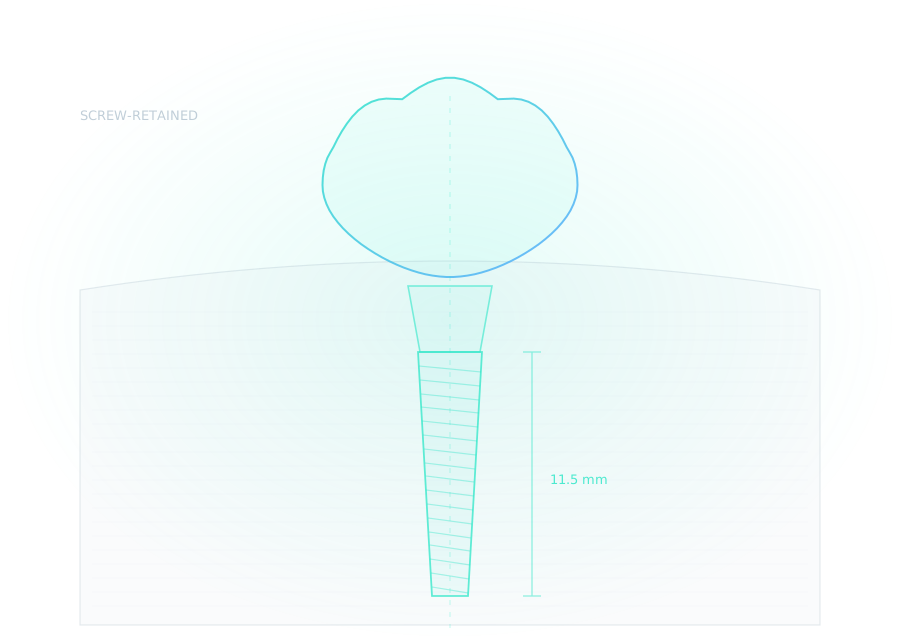
Screw access emergence is a planning constraint, not a finding. In a prosthetically driven workflow you know before committing whether access emerges through the cingulum or the incisal edge, and whether that forces you to a cement-retained design or an angulated channel.
The tell is discovering it afterwards. If the phrase "we will deal with the access at the restorative stage" appears, the sequence has already inverted.
3. Emergence profile was never modelled
The transition from implant platform to crown contour is determined at planning by depth and axis. Too shallow and the emergence is abrupt with no room to develop a natural profile; too deep and the margin becomes uncleansable.
This is decided the moment the implant position is fixed, and it is rarely revisited. A plan that shows the implant but not the emergence has left the most aesthetically consequential decision unexamined.
4. The guide was designed after the position, not with it
A surgical guide is meant to transfer a prosthetically determined position into the mouth. Where it is generated as a downstream artefact of a position already chosen from bone, it faithfully transfers a compromise, with excellent accuracy, which is what makes it convincing.
Full-arch is where this compounds
On a single unit a poor axis is a restorative inconvenience. Across a full arch, multi-unit positions determine whether the prosthesis can be screw-retained at all, whether the conversion prosthesis will seat, and whether the final framework has adequate cross-section where it needs it.
Verification jigs exist because these errors are cumulative and invisible until the framework does not fit passively. Planning backwards from the prosthesis is not a preference at full-arch. It is the only sequence that produces a restorable result reliably.
The question that settles it
If you want to know which sequence a plan came from, one question does it: what would have had to change if the bone had been worse?
In a prosthetically driven plan there is an answer, because the constraint was met and a decision made: graft, angle, change the design, or move the tooth position deliberately. In a bone-driven plan the honest answer is “nothing, we would have placed it wherever the bone allowed”, which is exactly the point.
What this means for how we plan
We plan in exoplan against a restoration that exists as geometry, and we report the constraints we found rather than resolving them silently. If the ideal position is not available in the bone you have, you will be told what the options are, so the compromise is yours to make and not one you inherit.
Planning and design support only. Diagnosis, treatment planning and clinical decisions remain entirely with the treating clinician.