

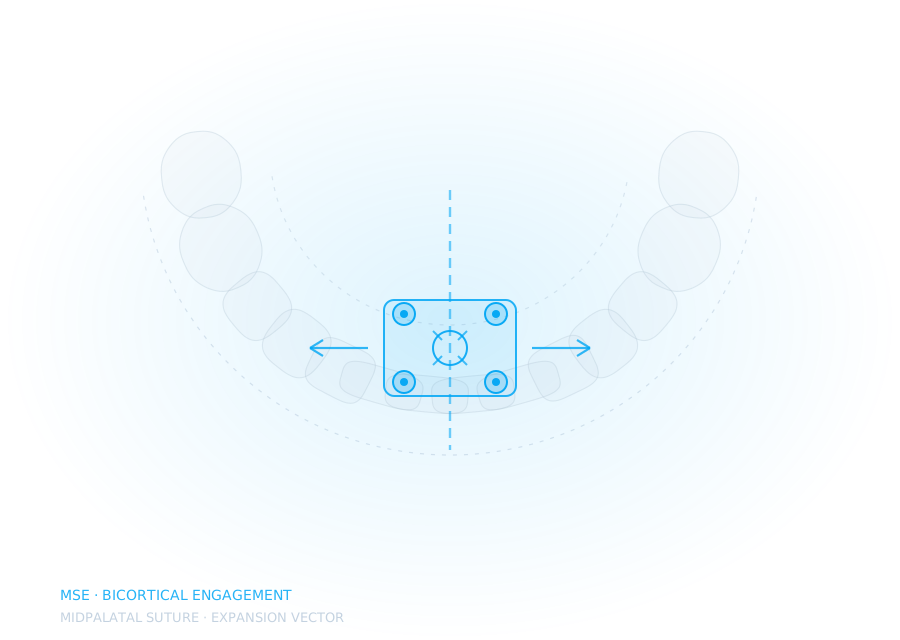
The question is not "is this patient too old". It is whether the midpalatal suture will separate under the force you can apply, through the anchorage you can achieve, in the bone that is actually present. Three separate assessments, and chronological age is a poor proxy for any of them.
Read the suture, not the birth certificate
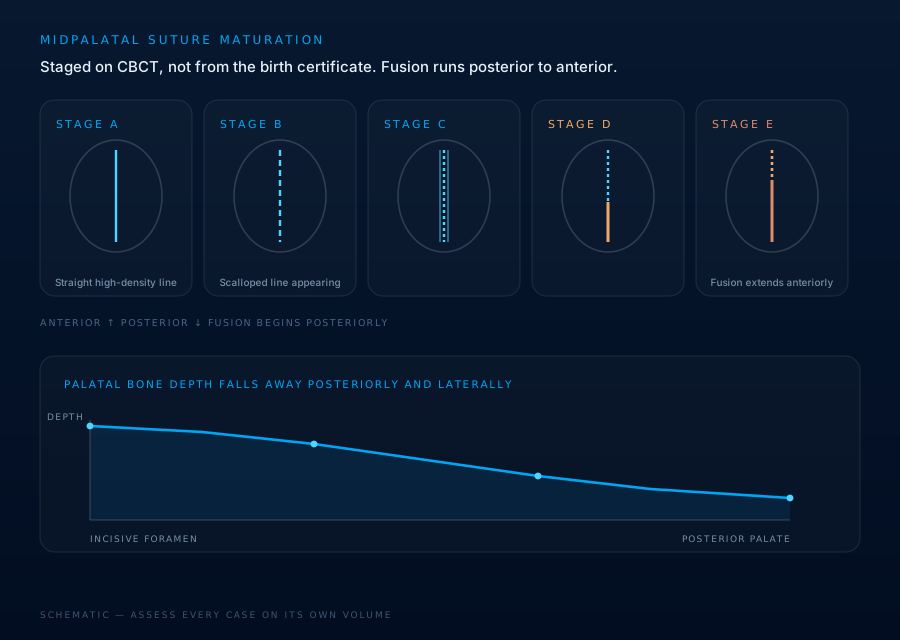
Midpalatal suture maturation is conventionally staged on CBCT, the Angelieri classification is the framework most people use, running from a straight high-density line in the young patient through progressive interdigitation to partial and then complete fusion, with the posterior segment fusing before the anterior.
Two things about it matter more than the staging itself.
First, the spread within any age band is enormous. Two patients of the same age can sit two stages apart. Any protocol that reads "under 15, expand; over 20, refer" is going to be wrong in both directions.
Second, the posterior suture fuses first, which is why parallel opening becomes progressively harder and why a fan-shaped, anteriorly-dominant opening is the common pattern in the older patient. If your treatment objective requires posterior width specifically, that matters more than the overall stage.
Assess it on a reconstructed axial slice through the palate, not on a single mid-sagittal view. And assess the whole length, the anterior and posterior thirds can differ.
Then read the bone you have to anchor into
A bone-borne expander transmits everything through the miniscrews. If they loosen, the appliance is a passive object. So before the frame is drawn, the question is where screws can be placed with enough bone to hold.
What we measure at every planned site:
- Palatal bone depth at the site, and whether bicortical engagement is achievable, engaging both the palatal cortex and the nasal floor cortex materially improves stability
- Cortical thickness, since primary stability comes largely from cortical engagement rather than total length
- Root proximity, particularly for paramedian sites near the premolar roots
- Distance from the greater palatine neurovascular bundle
- Nasal floor position, which sets the ceiling on screw length before you perforate
Bone depth in the palate falls off posteriorly and laterally. Sites that look equivalent on a model are not equivalent in the volume, which is the entire argument for planning screw position before appliance geometry, rather than placing a frame and then finding somewhere for the screws to go.
Where the three options actually differ
Tooth-borne and hybrid
Adequate where the suture is genuinely immature and the objective is dental as much as skeletal. The cost is well documented: buccal tipping of the anchor teeth, root resorption risk, and a skeletal-to-dental ratio that worsens as the suture matures. In a patient where you need skeletal width, spending force on tipping molars is spending it in the wrong place.
Bone-borne: MSE and MARPE
Force is applied closer to the suture and through skeletal anchorage, so more of it does skeletal work. Where the suture will still separate, this is the option that gets the most parallel, most skeletal result for the least dental cost.
The failure mode is specific and worth naming: the screws hold, the suture does not open, and force accumulates without expansion. That produces pain, sometimes screw loosening, and a patient who has been through the appliance for nothing. Which is why the pre-operative assessment matters more here than with any tooth-borne design.
Surgically assisted — SARPE
Where the suture is fused and the width requirement is real, surgical release stops being the aggressive option and becomes the predictable one. The relevant comparison is not "surgery versus no surgery". It is surgery versus a failed non-surgical attempt followed by surgery anyway, with the patient's confidence spent in between.
How the decision usually falls out
Combining the two readings gives four broad situations. These are not thresholds. They are the shape of the decision, and every case still turns on its own volume and its own objective.
- Immature suture, adequate palatal bone. Bone-borne expansion is well supported. The question becomes design rather than feasibility
- Immature suture, limited bone at the preferred sites. Feasible, but anchorage is the constraint. Site selection moves anteriorly where depth is greater, and bicortical engagement matters more
- Partially fused suture, adequate bone. The genuine grey area — worth attempting in a motivated patient told plainly it may not open, with a defined point at which you stop
- Fused suture. Surgical release. Forcing a fused suture through miniscrews does not produce slow expansion; it produces pain, screw loosening, and months spent on nothing
The most useful thing you can do before committing is decide in advance what will tell you it is not working, and what you will do at that point. An expansion protocol without a stopping rule runs until the patient complains.
The honest middle
The clear cases decide themselves. The difficulty is the partially fused suture in the adult who wants to avoid surgery, where a non-surgical attempt is neither clearly reasonable nor clearly futile.
Planning and design support only. Diagnosis, treatment planning and clinical decisions remain entirely with the treating clinician.