

What this is for
You planned a movement. Something happened. Between those two facts sits every piece of information that would make the next case better, and it stays invisible unless somebody measures it.
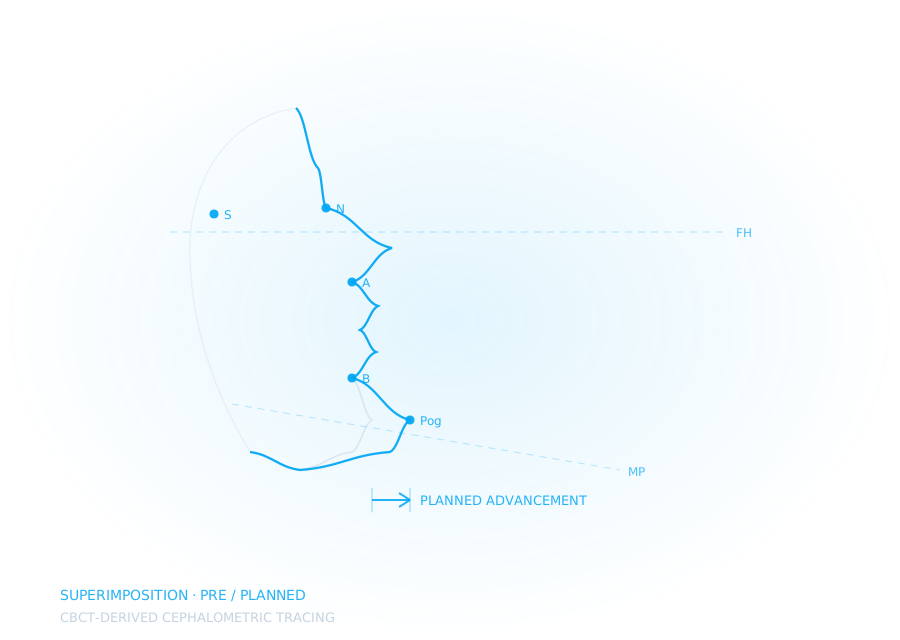
An outcome audit compares the plan against a post-treatment record and reports the deviation, landmark by landmark, with an interpretation of where it most likely came from.
What we need
- The original plan file, or the planned position in a form we can register against
- A post-treatment CBCT or scan, at a defined interval — twelve months is a common choice for surgical cases, once remodelling has largely settled
- Comparable acquisition. Same field of view where possible, and voxel sizes that are not wildly different
- The interval, stated, and anything that happened in it that we should know about
The registration is the whole method
A superimposition is a claim about what did not move. Get that wrong and every number downstream is wrong in a way that looks entirely convincing.
For skeletal work the anterior cranial base is the conventional reference, because it is largely complete early and stable thereafter. For regional questions — did this segment move as planned relative to that one — the appropriate reference is regional and has to be chosen deliberately.
We state which structures the registration used. If you disagree with the choice, the numbers can be regenerated against a different one. A superimposition that does not disclose its reference is not a measurement; it is a picture.
What the numbers can and cannot tell you
They can tell you the magnitude and direction of the difference between planned and achieved position at defined landmarks. That is worth a great deal and is rarely available.
They cannot, on their own, tell you the cause. A shortfall in projection might be surgical positioning, might be relapse, might be remodelling, might be a plan that was never achievable with the fixation used. Attributing it takes the clinical context, which is yours. We will offer an interpretation and label it as one.
What you receive
- The superimposition, rendered so it can be shown and understood
- Deviation at each landmark, in millimetres and degrees, with direction
- The registration method, stated explicitly
- A written interpretation, with its uncertainty made clear
Why it is worth doing
Two reasons. The first is that it closes the loop — you find out whether your planning assumptions hold in your hands, with your surgical team, in your patients. Nobody else can tell you that.
The second is that a documented outcome is a different kind of evidence from a before-and-after photograph. It is measurable, it is reproducible, and it is the sort of thing that supports a presentation, a publication or a difficult conversation.
Timeline
One working day from comparable records.
Planning and design support only. Diagnosis, treatment planning and the clinical decision remain entirely with the treating clinician.