
Why soldered designs fail where they fail
A soldered or welded junction differs from the parent metal in composition, in grain structure and in how it responds to cyclic load. It is also, by the nature of the design, placed where an arm meets a body — which is where bending moment peaks.
So fractures cluster there, and they recur there after repair, because the repair reproduces the condition that caused the first one. A framework that has broken twice at the same junction is not unlucky.
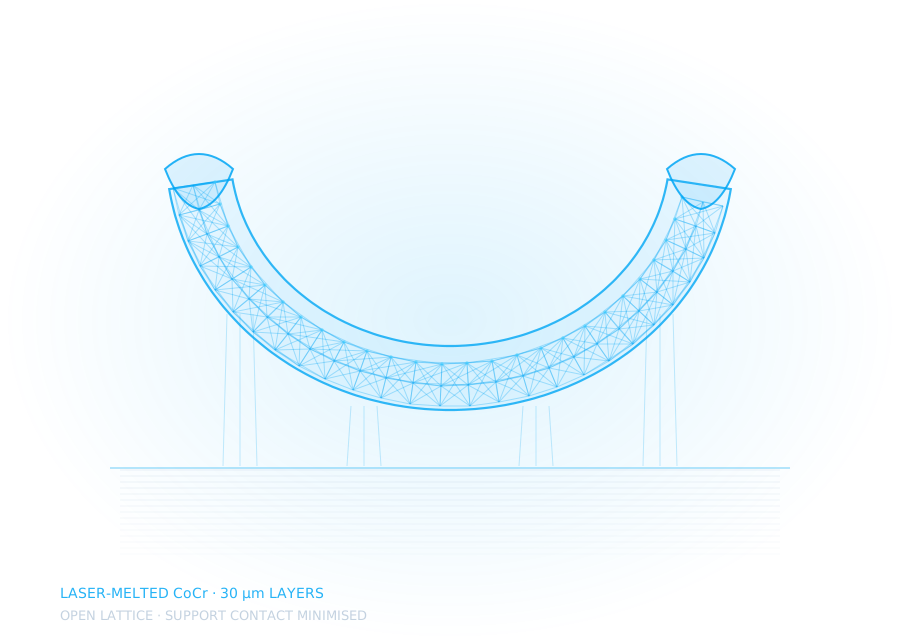
Laser melting builds the whole framework as a single continuous body. There is no filler alloy, no heat-affected zone, no interface. The stress still concentrates in the same region — geometry decides that — but it is concentrating in solid parent metal rather than at a discontinuity.
What we need from you
- Intraoral scan, full arch, with the palatal vault captured to its full depth where the design uses it
- The appliance specification — what it has to do, which teeth it engages, what it must clear
- The previous appliance if one failed, or a photograph of the fracture. Where it broke tells us what the geometry was doing
- Any clearance constraints — opposing occlusion, tongue space, existing restorations
What changes in the design
One-piece construction removes a constraint and adds others. Worth knowing before you specify:
- Cross-sections can vary continuously rather than being limited to available wire gauges, so material goes where the stress is instead of uniformly
- Transitions are filleted, not abrupt. A generous radius at an arm root does more for fatigue life than added bulk
- Build orientation matters and is decided at design stage, not at the printer
- Support contact leaves witness marks. These are placed deliberately, away from tissue-contacting and load-bearing surfaces
- Adjustability is reduced. A one-piece framework is stiffer and less forgiving of chairside bending — which is the point, and also the trade-off
That last one is the honest caveat. If your workflow depends on adjusting the appliance in the mouth, a printed one-piece design fights you. The fit has to be right from the scan instead.
What leaves the lab
- The framework design, with cross-sections and fillet radii set for the load path rather than defaulted
- Build orientation and support strategy
- Pad and band interfaces matched to the actual tooth surfaces
- Print-ready files, or the finished framework where we are arranging production
Where these go wrong
- An incomplete scan — a vault that stops at the gingival margin leaves nothing to seat a frame on
- Cross-sections carried over from wire thinking, which wastes the main advantage of the process
- Sharp internal transitions, which concentrate stress as effectively as a solder joint did
- An expectation of chairside adjustment that the material will not support
Timeline
Three working days for design. Production time depends on the bureau and the build; you get the real date in the quote.
Planning and design support only. Diagnosis, treatment planning and the clinical decision remain entirely with the treating clinician.